Why a website doesn’t bring clients (and what to do about it)
Recently, a small online store owner reached out to me.
The website was built six months ago — modern, fast, visually appealing.
But sales are low.
– What’s wrong with the website?
– Nothing. The problem is that no one comes to it.
This isn’t an isolated case. Most clients expect that once a website is live, customers will appear. Reality is harsher: the website exists, but there are no clients.
The uncomfortable truth: a website is not advertising
A website alone does not bring clients.
It doesn’t generate demand, doesn’t make people Google your product, and doesn’t magically appear in their social feeds.
This is especially painful in e-commerce. Your online store may work perfectly and load in seconds, but without advertising, SEO, marketplace presence, or at least word of mouth, it simply stands empty.
And that’s normal. Because a website has a different role.
So why do you need a website?
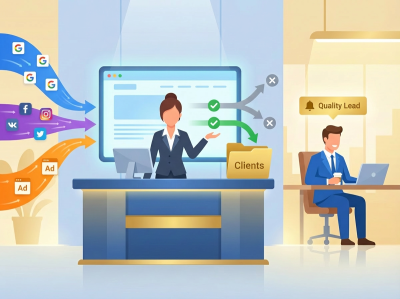
A good website doesn’t catch clients — it works with those who already arrived.
From ads, Instagram, recommendations, or search.
The person is already interested. Already looking for a solution.
That’s where the website’s real job begins.
Task #1: Turn interest into action
Once a visitor lands on your site, you have 10–15 seconds.
The website must quickly say: “Yes, you’re in the right place. We solve your problem. Here’s what to do next.”
I’ve seen cases where conversion rates increased significantly after a redesign with the same traffic.
Not because the site became prettier — but because it became clearer. People understood what to do within 30 seconds and did it.
Task #2: Filter out the wrong clients
It may sound strange, but a good website should repel unsuitable clients.
When I build websites for premium services, we intentionally show pricing levels, requirements, and working format. Yes, some people leave. But those who stay already understand the rules of the game. Fewer “can I get a discount?” questions and fewer clients who are simply not a good fit.
This saves your time and energy.
Task #3: Sell without your involvement
Imagine a sales manager who:
- works 24/7 without days off
- never gets tired of answering the same questions
- never forgets important details
- shows exactly what’s needed to make a decision
That’s your website. Or rather, what it can become.
A good website handles objections before any conversation, answers common questions, and shows examples. As a result, you get “warm” leads — people who already know what they want.
The biggest mistake when ordering a website
The problem isn’t that people order websites. The problem is the mindset:
“Let’s build a website — and everything will start working.”
A website is not magic. It’s a tool in a chain:
Ads / Search → Website → Lead → Sale
If the website falls out of this logic (it’s unclear what to do, or it doesn’t answer questions), traffic is wasted. You pay for clicks, and people leave.
Where website development really starts
Before starting, we do a short analysis. I ask a few questions about your business and your clients.
Don’t worry if you don’t have clear answers yet — that’s normal.
Before development, we collect the questions and work on finding the answers.
Here’s what we discuss:
1. Where will clients come from?
Google Ads? Facebook? Sales via hv.ee? Email campaigns?
→ Not sure? We’ll look at competitors and identify 2–3 starting channels.
2. What do clients want to know first?
Usually: price, timelines, guarantees. Sometimes it’s more important to show examples or explain how it works.
→ Unsure? I’ll help extract this from your past client conversations.
3. Why should clients choose you?
Low price? Premium quality? Fast delivery? Personal approach?
→ Hard to answer? Then this is the first thing to define.
4. What doubts do clients have?
“Too expensive”, “afraid of being scammed”, “not sure about quality” — the website should address these before any call.
→ Not sure? Just recall your last five client conversations.
5. What should the website do?
Accept orders? Collect leads? Show a portfolio and drive calls?
→ The simplest question — you usually already know the answer.
Why does all this matter?
A website is not just pretty visuals.
It’s a tool that solves specific business tasks.
Not sure where to start?
Write to me — we’ll figure it out together.